Do People Speak English in Switzerland? (My Honest Advice)
When I first planned my Interrail trip, I kept asking myself: do people speak English in Switzerland? After spending time in Zurich, Bern and several Alpine villages, I quickly realised just how easy it is to travel here using English — but there’s more to it than a simple yes or no.
If you’re planning a trip and wondering, do people speak English in Switzerland? The short answer is yes – very widely.
Switzerland is officially multilingual, with four national languages: German, French, Italian and Romansh. But English is commonly spoken across the country, particularly in cities, tourist areas and business settings.
As a visitor, you’ll find that most people working in tourism – hotel staff, restaurant teams, tour guides and shop assistants – speak fluent English.
This was absolutely my experience during time spent in Zurich, Bern, and several Alpine villages over two Interrail trips in 2023 and 2024.
Menus are often available in English, transport announcements frequently include English, and signage in major stations is easy to follow. And of course, there’s always Google Translate if you get stuck.
So yes – enjoying Slow Travel in Switzerland using only English is entirely realistic.
Do People Speak English In Switzerland Beyond Tourist Areas?
Although English isn’t one of Switzerland’s official languages, it’s widely used in:
- Education
- International business
- Tourism
- Academia
- Technology and finance
English is taught in Swiss schools, and many university courses are delivered partly or entirely in English.
Switzerland is also home to many global companies and international organisations, where English is often the shared working language between multilingual teams.
During both of my Interrail trips, I never had communication issues.
Even when I tried (very basic!) German or French, people were quick to switch to English when needed – and usually spoke it extremely well.

Language In Switzerland
Switzerland has four official languages:
- German
- French
- Italian
- Romansh
The language spoken depends on the canton (region) you’re visiting.
English proficiency in Switzerland is consistently high. In fact, Switzerland regularly ranks among the top countries globally on the EF English Proficiency Index – a strong indicator that most Swiss residents can comfortably communicate in English.
In addition, Switzerland has a large international community. Expats working in finance, healthcare, pharmaceuticals, technology and diplomacy frequently use English as their primary workplace language.
My Favourite Things About The Languages Of Switzerland
1. What language is spoken in Switzerland?
Switzerland is divided linguistically by region:
- German is the most widely spoken.
- French dominates the west.
- Italian is spoken in the south.
- Romansh is spoken by a small minority.
German-speaking Switzerland actually speaks “Swiss German” dialects in daily conversation, which can sound very different from standard German – something I found fascinating while visiting Lucerne.
2. Are languages regionally based?
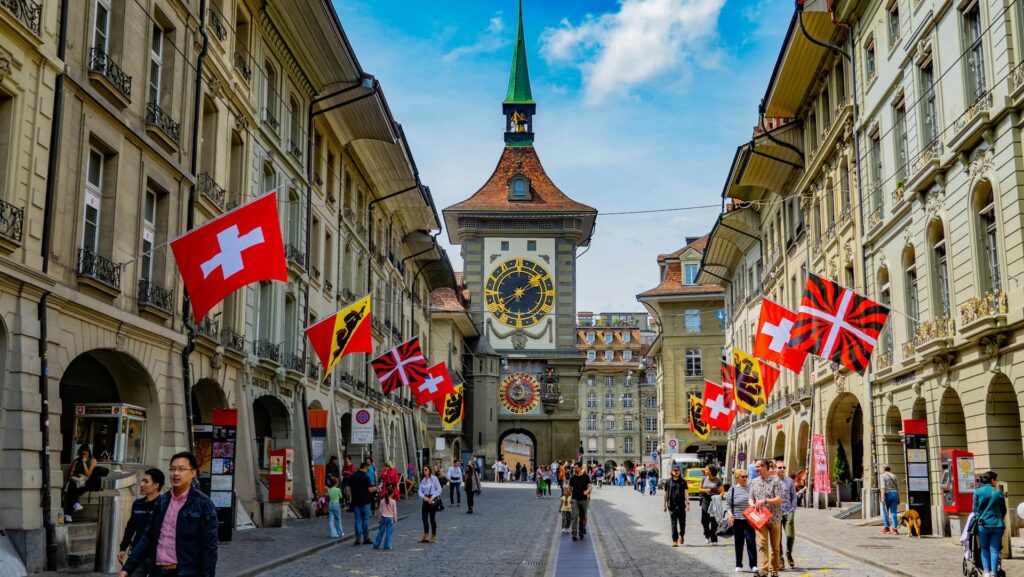
Yes – very clearly.
If you’re asking “do people speak English in Switzerland?” it helps to understand where you’re travelling.
- The German-speaking region includes Zurich, Bern, and Lucerne.
- The French-speaking region includes Geneva and Lausanne.
- The Italian-speaking region centres around Ticino.
- Romansh is spoken mainly in Grisons (Graubünden).
Even in these distinct language regions, English is commonly understood – especially in cities and transport hubs.
3. Choosing the local official language
Each canton determines its official language based on geography and history. This local autonomy is part of what makes Switzerland so culturally unique.
Despite the regional differences, English often acts as a “bridge language” between Swiss people from different cantons – especially in business and higher education.
4. Does language change with age?

Yes – younger generations tend to have higher English proficiency.
English is taught from primary school in most cantons, meaning younger Swiss residents are typically very comfortable speaking it.
That said, even among older generations, I rarely struggled to communicate in English – particularly in public-facing roles.
All this helps make Switzerland perfect for slow travel.
5. Embrace the local language
Even though English is widely spoken in Switzerland, learning a few local phrases goes a long way.
Slow travel is about connection – and making an effort in German, French or Italian shows respect and often leads to warmer interactions.
You don’t need fluency. Just a few basics can change the tone of a conversation completely.
Common Words To Learn Before Visiting Switzerland
While many people do speak English in Switzerland, using a greeting in the local language is always appreciated.
Greetings
Switzerland has four official languages, and greetings vary by region:
- Grüezi – Hello (Swiss German)
- Bonjour – Hello (French)
- Buongiorno – Hello (Italian)
- Allegra – Hello (Romansh)
Basic Phrases
- Bitte – Please
- Danke – Thank you
- Ja – Yes
- Nein – No
- Entschuldigung – Excuse me
- Sprechen Sie Englisch? – Do you speak English?
Ordering Food & Drinks
- Eine Tasse Kaffee, bitte – One coffee, please
- Ich hätte gerne ein Stück Kuchen – I would like a piece of cake
- Ich hätte gerne ein Glas Wein – I would like a glass of wine
- Die Rechnung, bitte – The bill, please
Transport
Switzerland’s public transport is excellent and easy to navigate.
- Ein Ticket nach Zürich, bitte – One ticket to Zurich, please
- Wo ist der Bahnhof? – Where is the train station?
- Wie viel kostet das Ticket? – How much is the ticket?
- Ich suche ein Taxi – I’m looking for a taxi
Speak English In Switzerland – FAQs
Do people speak English in Switzerland?
Yes. You can absolutely travel Switzerland speaking only English. English is widely spoken across cities, tourist regions and business settings. Most hospitality staff speak fluent English.
Is English widely understood in Zurich?
Yes. In Zurich, English is extremely common, especially among younger residents and professionals. You’ll rarely encounter communication issues.
What percentage of the population speaks English in Switzerland?
Estimates suggest around 40–45% of the population speaks English well, with even higher proficiency in urban areas and among younger generations.
Can you work in Switzerland without speaking a local language?
It depends on the industry. Many multinational companies operate in English, especially in finance, pharmaceuticals, research and tech. However, for customer-facing roles, a local language is often required.
Do you need French when visiting western Switzerland?
In cities like Geneva, French is the dominant language. However, English is still widely understood – particularly in hospitality and international environments.
Is English compulsory in Swiss schools?
English is widely taught but education policy varies by canton. That said, English remains the most commonly taught foreign language and is heavily used in higher education and business.
My Final Thoughts
So – do people speak English in Switzerland? Yes, comfortably and widely.
But while you can absolutely travel Switzerland using only English, learning a few local phrases adds depth to your experience. Switzerland’s multilingual identity is part of what makes it so special.
For slow travellers especially, making the effort – even imperfectly – opens doors.
And honestly? Some of my favourite travel moments came from attempting Swiss German and being gently corrected with a smile.